


The Middle East has become one of the most attractive regions for international professionals seeking high-paying jobs, tax-free salaries, and global career exposure. Among the top destinations, Dubai (UAE) and Qatar consistently stand out as two of the most promising places for expatriates looking to build a successful career. Both countries offer modern infrastructure, thriving economies, and competitive salary packages that attract workers from Asia, Europe, Africa, and beyond.
However, choosing between jobs in Dubai vs. jobs in Qatar is not always straightforward. While both markets offer lucrative opportunities, they differ in terms of average salary levels, cost of living, lifestyle expenses, work culture, and long-term financial benefits. For example, Dubai is often considered a global business hub with a highly diversified economy, while Qatar’s economy is heavily supported by its vast natural gas reserves and large infrastructure investments.
Another factor that makes this comparison important is the actual savings potential. Many professionals initially look at gross salaries when evaluating job offers, but what truly matters is how much money remains after covering housing, transportation, food, and lifestyle expenses. A higher salary in one country may not necessarily mean better financial outcomes if living costs are significantly higher.
In recent years, both Dubai and Qatar have also expanded their employment sectors. Dubai has seen massive growth in technology, tourism, finance, real estate, and digital entrepreneurship, while Qatar has accelerated development in energy, construction, aviation, and sports infrastructure, especially after hosting the FIFA World Cup 2022, which left behind a legacy of investment and job opportunities.
This comprehensive guide explores the salary comparison, cost of living, job opportunities, and overall quality of life in Dubai and Qatar. By the end, you will have a clear understanding of which destination might be the better choice for your career goals, financial growth, and lifestyle expectations.
Understanding the Gulf Job Market in 2026
The Gulf job market continues to evolve rapidly, driven by economic diversification, digital transformation, and large-scale infrastructure projects. Countries like the United Arab Emirates and Qatar are actively reducing their reliance on oil revenues and investing heavily in sectors such as technology, finance, tourism, renewable energy, and logistics. This shift has created thousands of new opportunities for both skilled professionals and entry-level workers across multiple industries.
One of the most attractive features of working in Gulf countries is the tax-free salary structure. Unlike many Western nations where income taxes can consume a significant portion of earnings, Dubai and Qatar allow employees to keep most of their income. This alone can dramatically increase saving potential, especially for expatriates who relocate from high-tax economies.
Another major factor shaping the job market is expatriate workforce dominance. In both Dubai and Qatar, expatriates represent a large portion of the population. In fact, expatriates make up approximately 85–90% of the population in the UAE and nearly 88% in Qatar, according to regional labor statistics. This means employers are accustomed to hiring international talent and providing relocation packages that include housing allowances, medical insurance, and annual flight tickets.
Technology has also changed the employment landscape in the region. Many companies in Dubai now offer roles in AI, fintech, cybersecurity, e-commerce, and digital marketing, while Qatar continues to expand in engineering, LNG energy operations, and construction management. This diversification means professionals with specialized skills often receive high salary packages and relocation benefits.
Another important trend is the growing emphasis on work-life balance and employee well-being. Many companies now provide flexible working arrangements, hybrid work models, and professional development programs to attract top talent. Dubai, in particular, has positioned itself as a global innovation hub, while Qatar is focusing on becoming a knowledge-based economy through investments in education and research.
Because of these economic transformations, choosing between Dubai and Qatar is no longer simply about salary. Professionals now evaluate career growth opportunities, lifestyle quality, long-term residency options, and the ability to save money when deciding which Gulf destination is the best fit for their ambitions.
Why Professionals Choose the UAE and Qatar
There are several reasons why millions of expatriates consider the Gulf region their preferred career destination. The first and most obvious advantage is the potential for significantly higher disposable income compared to many other parts of the world. Since both countries offer tax-free income, professionals can accumulate savings much faster than they would in high-tax economies such as the United States, Canada, or many European nations.
Another compelling reason is the global exposure and career advancement opportunities available in both markets. Dubai hosts regional headquarters for numerous multinational corporations, including companies in finance, technology, consulting, aviation, and luxury retail. Working in such an environment allows professionals to build international networks and gain valuable experience that enhances their career prospects globally.
Qatar, on the other hand, offers strong opportunities in energy, infrastructure development, and government-backed mega projects. The country holds the title of one of the world’s largest exporters of liquefied natural gas (LNG), which generates enormous revenue and fuels continued economic development. This translates into stable employment prospects for engineers, project managers, energy specialists, and technical professionals.
Lifestyle is another key attraction. Both Dubai and Qatar offer world-class infrastructure, modern healthcare systems, international schools, luxury shopping centers, and safe living environments. Dubai is particularly known for its vibrant social life, entertainment venues, and tourism attractions, while Qatar provides a quieter, family-oriented lifestyle with high standards of living.
Finally, many expatriates choose these destinations because of generous employment benefits. These can include housing allowances, transportation allowances, annual flight tickets to home countries, medical insurance, and end-of-service gratuity payments. Such benefits significantly enhance the overall compensation package and make relocating to the Gulf financially rewarding.
Understanding these motivations helps explain why the Dubai vs. Qatar job comparison is one of the most common considerations among professionals planning to move to the Middle East for work.
Overview of Dubai’s Employment Market
Dubai has transformed itself from a small trading port into one of the world’s most dynamic business centers. Today, the city is widely recognized as the commercial capital of the Middle East, hosting thousands of multinational corporations and startups across various sectors. Its strategic location between Europe, Asia, and Africa makes it an ideal hub for international trade and business expansion.
The government of the United Arab Emirates has played a significant role in building this thriving economy. Through initiatives such as Dubai Vision 2030, Smart Dubai, and UAE Digital Economy Strategy, authorities have invested heavily in technology, infrastructure, and innovation. These policies have created an environment where businesses can grow rapidly, which in turn generates a steady demand for skilled professionals.
Dubai’s labor market is highly diverse. Professionals from more than 200 nationalities work in the city across sectors ranging from banking and finance to hospitality and aviation. Major global companies like Emirates Airline, DP World, Amazon Middle East, Microsoft, and HSBC maintain strong operational bases in Dubai, providing thousands of high-paying job opportunities.
Another factor that makes Dubai attractive for job seekers is its entrepreneurial ecosystem. Free zones such as Dubai Internet City, Dubai Media City, and Dubai International Financial Centre (DIFC) offer tax incentives and business-friendly regulations that attract startups and tech companies. As a result, job opportunities are expanding rapidly in fields such as software development, digital marketing, fintech, data science, and AI engineering.
The city also continues to grow as a tourism and hospitality powerhouse, welcoming more than 17 million international visitors annually before the pandemic and steadily returning to those numbers. This creates consistent employment opportunities in hotels, travel services, event management, and luxury retail.
Overall, Dubai’s employment market is known for its fast-paced environment, international exposure, and strong salary packages, making it one of the most competitive yet rewarding job markets in the Middle East.
Major Industries Hiring in Dubai
Dubai’s economic diversity is one of its strongest advantages when it comes to employment opportunities. Unlike many Gulf countries that rely heavily on oil and gas revenues, Dubai has successfully developed multiple industries that contribute to job creation and economic stability. This diversification ensures that professionals from a wide range of backgrounds can find opportunities that match their skills and career goals.
One of the largest sectors in Dubai is finance and banking. The Dubai International Financial Centre (DIFC) hosts hundreds of financial institutions, including global banks, investment firms, and fintech startups. Professionals working in financial analysis, investment management, risk assessment, and corporate banking often receive some of the highest salary packages in the region.
Another major industry is tourism and hospitality. Dubai is home to iconic attractions such as the Burj Khalifa, Palm Jumeirah, and Dubai Mall, which attract millions of visitors each year. This thriving tourism sector supports thousands of jobs in hotel management, event planning, restaurant operations, and travel services.
The real estate and construction sector also remains a key driver of employment. With ongoing mega projects such as luxury waterfront communities, commercial skyscrapers, and smart city developments, engineers, architects, and project managers are constantly in demand.
Technology is quickly becoming one of Dubai’s fastest-growing industries. Government initiatives promoting artificial intelligence, blockchain, and digital transformation have created demand for highly skilled tech professionals. Roles such as data scientists, cybersecurity analysts, cloud engineers, and software developers are particularly lucrative.
These industries collectively make Dubai a global employment magnet, attracting professionals seeking both financial rewards and career advancement.
High-Demand Jobs in Dubai
Dubai’s job market is highly competitive, but certain professions consistently remain in strong demand due to the city’s rapid economic growth and technological transformation. Professionals with specialized expertise often command premium salaries, relocation packages, and additional benefits that make working in Dubai financially rewarding. The demand for talent is particularly strong in sectors that contribute directly to the city’s development as a global business hub.
One of the most sought-after categories is technology and digital transformation roles. Companies across industries are investing heavily in digital infrastructure, automation, and artificial intelligence. As a result, positions such as software developers, cybersecurity specialists, AI engineers, and data analysts have become some of the highest-paying jobs in Dubai. Experienced professionals in these fields can earn anywhere between AED 18,000 and AED 45,000 per month, depending on their expertise and the size of the organization.
Another high-demand sector is finance and corporate management. Dubai hosts regional headquarters for many multinational banks and investment firms. Professionals working as financial analysts, chartered accountants, investment advisors, and compliance managers often enjoy strong salary packages along with performance bonuses. Senior-level executives in finance can easily earn AED 40,000 or more per month, particularly within international banking institutions.
The construction and engineering industry continues to thrive due to large-scale infrastructure and real estate projects. Engineers, architects, and project managers are essential to the completion of these developments. Civil engineers and project managers working on major developments can earn between AED 15,000 and AED 35,000 monthly, depending on their experience and specialization.
Healthcare is another rapidly growing sector. Dubai has been investing significantly in medical tourism and advanced healthcare facilities. This has increased demand for specialist doctors, surgeons, nurses, and healthcare administrators. Experienced medical professionals often receive lucrative packages that include housing allowances and education benefits for children.
A quick overview of typical monthly salaries in Dubai highlights the earning potential across key professions:
| Profession | Average Monthly Salary (AED) |
|---|---|
| Software Engineer | 18,000 – 35,000 |
| Financial Analyst | 15,000 – 30,000 |
| Civil Engineer | 12,000 – 25,000 |
| Marketing Manager | 14,000 – 28,000 |
| Medical Specialist | 30,000 – 60,000 |
These figures demonstrate why Dubai continues to attract ambitious professionals seeking both financial growth and international career exposure.
Overview of Qatar’s Employment Market
Qatar has developed one of the strongest economies in the Middle East, largely supported by its vast reserves of natural gas and petroleum resources. The country is widely recognized as the world’s largest exporter of liquefied natural gas (LNG), which generates significant national income and funds large infrastructure and development projects. Because of this wealth, Qatar has been able to invest heavily in modern cities, transportation networks, and world-class facilities that create employment opportunities for thousands of expatriates.
Over the past decade, Qatar has focused on implementing its long-term national strategy known as Qatar National Vision 2030. The goal of this initiative is to transform the country into a diversified and sustainable economy that is less dependent on hydrocarbons. As part of this plan, the government has invested billions of dollars into sectors such as education, healthcare, renewable energy, and advanced infrastructure.
The massive development leading up to the FIFA World Cup 2022 significantly boosted employment in construction, engineering, hospitality, and logistics. Although the tournament has already concluded, many of the infrastructure projects have created a long-lasting economic impact, continuing to generate jobs in facility management, tourism services, and event operations.
Compared to Dubai, Qatar’s job market is slightly smaller but often provides higher base salaries for technical and energy-related roles. Many expatriates working in oil and gas companies, engineering firms, and government-backed projects receive extremely competitive compensation packages that include housing, transportation allowances, and education benefits.
Another attractive aspect of working in Qatar is its relatively stable and structured corporate environment. Many positions are associated with government institutions, energy companies, and multinational engineering firms. Because of this, employees often experience longer contract durations and structured career progression.
Although Qatar’s lifestyle may appear quieter than Dubai’s fast-paced metropolitan environment, it offers excellent living standards, high safety levels, and modern infrastructure. The capital city, Doha, features luxury shopping malls, international restaurants, museums, and a growing cultural scene that continues to attract professionals and families from around the world.
Key Industries Driving Jobs in Qatar
Qatar’s employment landscape is heavily influenced by the industries that contribute the most to the country’s economic growth. While energy remains the backbone of the economy, several other sectors have expanded significantly in recent years, creating diverse job opportunities for expatriates and skilled professionals.
The most dominant industry in Qatar is undoubtedly the oil and gas sector, particularly natural gas production. Companies such as QatarEnergy, ExxonMobil, Shell, and TotalEnergies operate large projects within the country. Engineers, geologists, drilling specialists, and energy analysts working in this sector often receive some of the highest salaries in the entire Middle East.
Construction and infrastructure development also play a major role in the Qatari job market. Massive investments in stadiums, highways, metro systems, and smart city projects have created thousands of jobs for civil engineers, architects, project managers, and skilled technicians. Even after the completion of World Cup projects, infrastructure maintenance and expansion continue to provide employment opportunities.
Another rapidly expanding sector is aviation and logistics. Qatar Airways has grown into one of the world’s most prestigious airlines, employing thousands of professionals in aviation operations, engineering, customer service, and management roles. The expansion of Hamad International Airport has further strengthened this sector.
Education and healthcare are also gaining importance as part of Qatar’s economic diversification strategy. International universities, research institutions, and advanced medical centers are being established across the country. This has created opportunities for teachers, researchers, doctors, and healthcare administrators.
Finally, Qatar is investing in tourism and hospitality, aiming to attract millions of visitors annually. Luxury hotels, resorts, cultural attractions, and sporting events are expanding the job market for professionals in hospitality management, event planning, and tourism services.
This combination of industries ensures that Qatar continues to provide strong employment opportunities, particularly for professionals with technical and specialized expertise.
High-Demand Jobs in Qatar
Just like Dubai, Qatar has several professions that consistently remain in high demand. However, the types of roles that command the highest salaries often differ due to the country’s heavy focus on energy production, infrastructure, and engineering projects.
Engineering professionals are among the most sought-after workers in Qatar. Positions such as petroleum engineers, mechanical engineers, electrical engineers, and project managers are essential to maintaining the country’s energy infrastructure and large-scale construction projects. Experienced petroleum engineers, for instance, can earn between QAR 30,000 and QAR 60,000 per month, depending on their qualifications and years of experience.
Another lucrative field is aviation. Qatar Airways employs thousands of professionals ranging from pilots and aircraft engineers to customer service managers. Senior aviation professionals can earn substantial salaries along with travel benefits and accommodation allowances.
Healthcare professionals are also in high demand. Qatar’s healthcare system has expanded rapidly, and hospitals are constantly recruiting specialist doctors, surgeons, and medical consultants. These professionals often receive highly attractive packages that include housing, transportation, and family benefits.
Finance and corporate roles are growing as well. Doha’s financial sector has expanded with institutions such as the Qatar Financial Centre, which attracts investment firms, insurance companies, and consulting agencies. Professionals working in finance, accounting, and corporate strategy can earn competitive salaries similar to those in Dubai.
A comparison of typical salaries in Qatar provides a clearer perspective:
| Profession | Average Monthly Salary (QAR) |
|---|---|
| Petroleum Engineer | 30,000 – 60,000 |
| Civil Engineer | 15,000 – 30,000 |
| Financial Manager | 20,000 – 40,000 |
| IT Specialist | 18,000 – 35,000 |
| Medical Specialist | 35,000 – 65,000 |
These figures highlight why Qatar continues to attract highly skilled professionals, especially those with expertise in technical and engineering disciplines.
Average Salary Comparison Between Dubai and Qatar
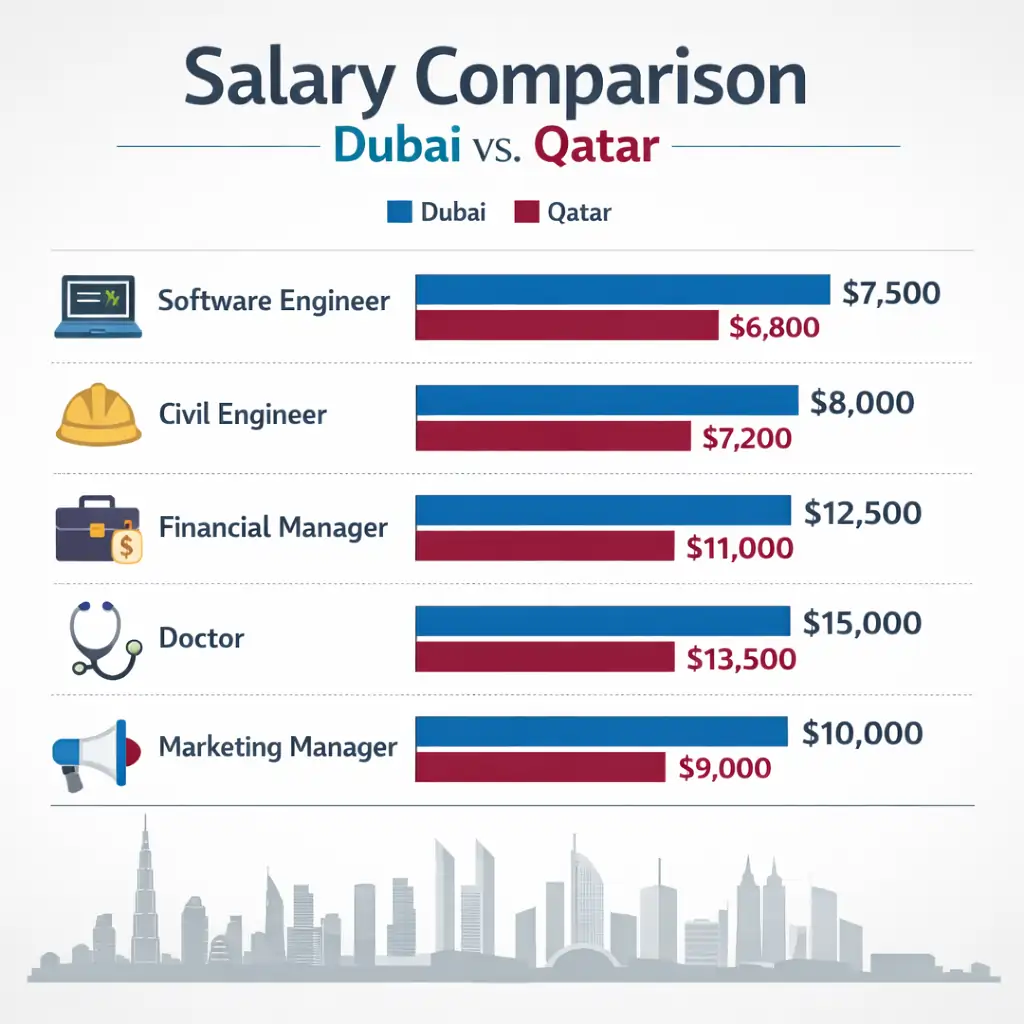
When professionals compare Dubai vs. Qatar jobs, salary is usually the first factor they examine. While both destinations offer tax-free income, the average salary levels can vary depending on the industry, experience level, and employer. In general, Dubai offers a wider range of employment opportunities across multiple sectors, while Qatar often provides higher base salaries for technical roles, particularly in oil and gas.
In Dubai, mid-level professionals typically earn between AED 12,000 and AED 30,000 per month, although senior managers and specialized experts can earn significantly more. Salaries in the technology, finance, and aviation sectors are particularly competitive due to the presence of multinational companies and regional headquarters.
Qatar, on the other hand, often provides slightly higher salaries in industries such as energy, engineering, and infrastructure development. Because many projects are government-funded or associated with large multinational energy corporations, employees frequently receive comprehensive compensation packages. These packages may include housing allowances, transportation benefits, international school fees, and annual airfare.
The key difference lies in salary structure. Dubai companies sometimes offer slightly lower base salaries but compensate with bonuses and career growth opportunities. Qatar employers often provide higher base pay along with generous allowances.
Ultimately, the best choice depends on your profession. Tech professionals, entrepreneurs, and marketing specialists often thrive in Dubai’s dynamic business ecosystem, while engineers and energy specialists may find Qatar’s salary packages more attractive.
Cost of Living in Dubai
While Dubai is famous for its tax-free salaries and luxurious lifestyle, the cost of living in Dubai can be relatively high compared to many other cities in the Middle East. The city is known for its modern skyscrapers, high-end shopping malls, world-class restaurants, and premium residential communities. All these features contribute to making Dubai an attractive destination, but they also influence everyday living expenses for residents.
The largest expense for most expatriates in Dubai is housing. Rent prices vary widely depending on the neighborhood and type of accommodation. For example, renting a one-bedroom apartment in a central area such as Downtown Dubai or Dubai Marina can cost anywhere between AED 6,000 and AED 10,000 per month. In more affordable neighborhoods like Al Nahda or International City, rents may range from AED 3,000 to AED 5,000 monthly. Many employers provide housing allowances, which significantly reduce this financial burden.
Transportation in Dubai is relatively affordable compared to Western cities. The city has a modern public transportation system that includes the Dubai Metro, buses, trams, and taxis. A monthly public transport pass typically costs around AED 300 to AED 350, making it a cost-effective option for daily commuting. However, many professionals prefer owning a car due to convenience, which adds expenses such as fuel, insurance, and maintenance.
Food expenses can vary depending on lifestyle choices. Dubai offers everything from inexpensive street food to luxurious fine dining experiences. On average, a single person might spend around AED 1,200 to AED 2,000 per month on groceries, while dining out regularly can increase this cost significantly. Fortunately, Dubai’s multicultural environment means there are affordable food options from many international cuisines.
Utilities such as electricity, water, and internet also contribute to monthly living costs. For a small apartment, basic utilities typically range between AED 500 and AED 800, while high-speed internet services cost approximately AED 300 to AED 400 per month.
A simplified estimate of average monthly living costs in Dubai looks like this:
| Expense Category | Average Monthly Cost (AED) |
|---|---|
| Rent (1-bedroom apartment) | 4,000 – 10,000 |
| Utilities | 500 – 800 |
| Groceries | 1,200 – 2,000 |
| Transportation | 300 – 1,200 |
| Entertainment & Dining | 1,000 – 2,500 |
Despite these expenses, many professionals still manage to save a significant portion of their income due to the absence of income tax. High-skilled workers earning competitive salaries can build substantial savings while enjoying a vibrant international lifestyle.
Housing, Transportation, and Daily Expenses
To truly understand the financial reality of living in Dubai, it’s important to break down the everyday costs that expatriates encounter. Housing, transportation, and lifestyle expenses collectively determine whether a professional can save money while working in the city.
Housing is often the biggest factor influencing financial planning. Dubai offers a wide range of accommodation options, from luxury apartments overlooking the Burj Khalifa to affordable studio flats in developing communities. Many expatriates share apartments with roommates to reduce rent costs, especially during the early stages of their careers. Sharing accommodation can reduce monthly rent expenses by 30–50%, allowing workers to allocate more income toward savings or investments.
Transportation costs depend largely on personal preferences. Dubai’s metro system is one of the most efficient in the region and connects major business districts such as Dubai Marina, Business Bay, and Downtown Dubai. For those who prefer driving, fuel prices remain relatively low compared to Europe or North America. Petrol costs roughly AED 3 per liter, making car ownership manageable for many residents.
Daily expenses such as groceries, gym memberships, entertainment, and shopping also vary depending on lifestyle. Budget-conscious individuals can live comfortably by shopping at discount supermarkets and cooking at home. Meanwhile, those who frequently visit high-end restaurants or luxury shopping centers may find their monthly expenses rising quickly.
Healthcare and insurance are typically covered by employers, which significantly reduces personal medical expenses. Dubai’s healthcare system is highly advanced, with numerous private hospitals and clinics offering international standards of care.
Ultimately, Dubai offers both luxury and affordability, depending on how individuals manage their spending habits. Professionals who maintain a balanced lifestyle often find it possible to enjoy the city’s amenities while still saving a considerable portion of their income.
Cost of Living in Qatar
Compared to Dubai, the cost of living in Qatar, particularly in the capital city of Doha, is often considered slightly lower in certain areas. While the country still maintains a high standard of living, many expatriates find that housing and daily expenses can be more manageable depending on their employer-provided benefits.
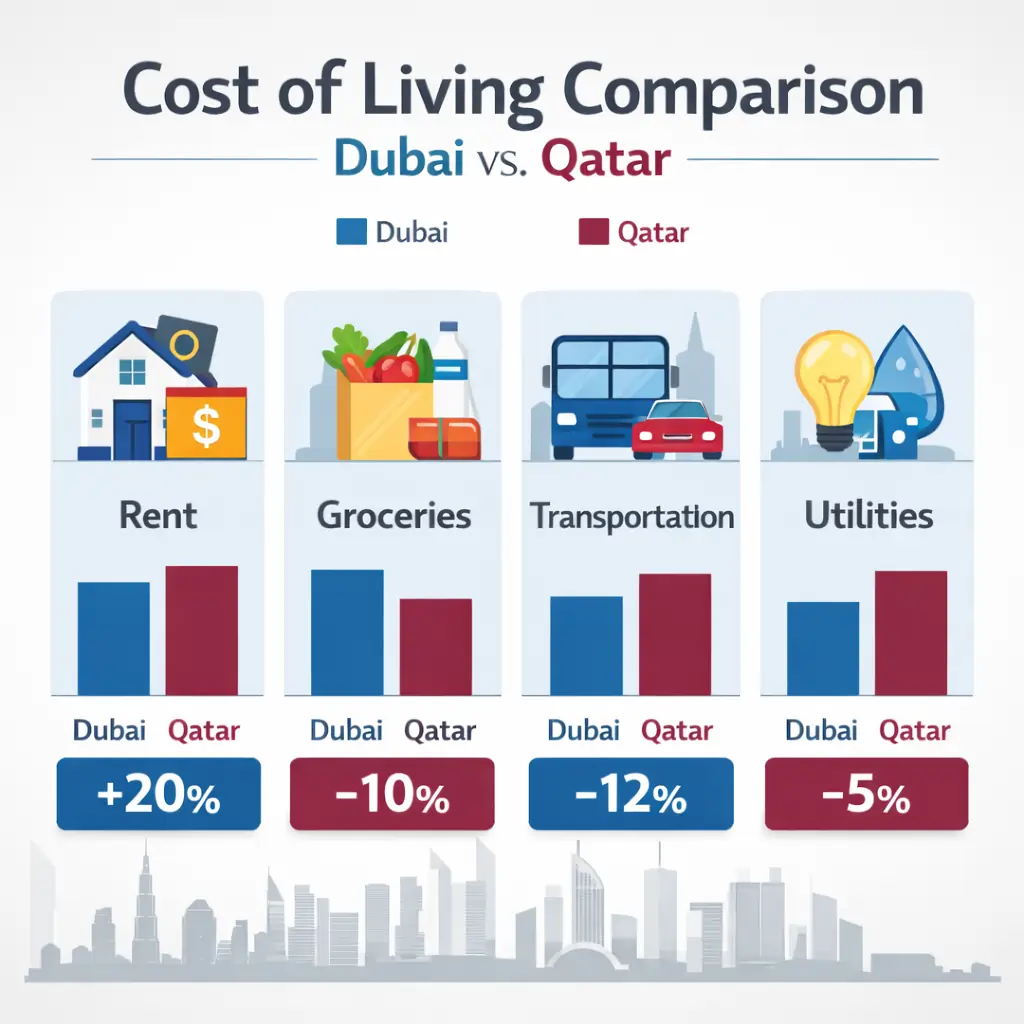
Housing costs in Qatar vary depending on location and property type. A one-bedroom apartment in central Doha may cost between QAR 4,000 and QAR 7,000 per month, while luxury apartments or villas in premium areas can exceed QAR 10,000 monthly. However, many expatriate employees receive housing allowances or company-provided accommodation, which significantly reduces their personal expenses.
Transportation in Qatar is relatively affordable. The Doha Metro, introduced in recent years, has improved connectivity across the city. Public transportation fares are inexpensive, typically costing QAR 2 to QAR 6 per trip. However, many residents rely on private cars because the city’s infrastructure is more car-oriented compared to Dubai.
Food costs in Qatar are similar to those in other Gulf countries. Monthly grocery expenses for a single person generally range between QAR 800 and QAR 1,500, depending on shopping habits and dietary preferences. International restaurants and luxury dining options are widely available, though frequent dining out can significantly increase monthly expenses.
Utilities such as electricity, water, and internet services are relatively affordable. Monthly utility bills for a small apartment usually range between QAR 300 and QAR 600, while internet services typically cost around QAR 250 to QAR 350 per month.
Here is a general breakdown of monthly expenses in Qatar:
| Expense Category | Average Monthly Cost (QAR) |
|---|---|
| Rent (1-bedroom apartment) | 4,000 – 7,000 |
| Utilities | 300 – 600 |
| Groceries | 800 – 1,500 |
| Transportation | 200 – 900 |
| Entertainment & Dining | 800 – 2,000 |
Although Qatar’s lifestyle may be quieter compared to Dubai’s energetic environment, many expatriates appreciate its lower congestion, relaxed pace of life, and family-friendly communities.
Housing, Utilities, and Lifestyle Costs
When evaluating the cost of living in Qatar, housing remains the most important factor influencing financial stability. Fortunately, many companies operating in the country—especially within the oil, gas, and engineering sectors—provide generous accommodation allowances or company-provided housing for employees. This benefit alone can dramatically increase an expatriate’s ability to save money.
Utilities in Qatar are relatively inexpensive due to government subsidies. Electricity and water bills are typically lower than those in many Western countries. Even during the hot summer months, when air conditioning usage increases significantly, the total cost remains manageable for most residents.
Lifestyle expenses also play a role in monthly budgets. Qatar offers a growing number of entertainment venues, shopping malls, sports facilities, and cultural attractions. Locations such as Katara Cultural Village, Souq Waqif, and The Pearl-Qatar provide unique experiences for both residents and tourists.
While nightlife options are more limited compared to Dubai, Qatar compensates with a strong focus on family-oriented activities, outdoor spaces, and cultural experiences. Many expatriates enjoy spending weekends exploring beaches, desert landscapes, or participating in sporting activities.
Overall, Qatar offers a comfortable lifestyle with slightly lower daily expenses than Dubai in many cases. For professionals who prioritize savings and stability over a fast-paced social environment, Qatar can be an attractive destination.
Taxation and Take-Home Salary
One of the biggest advantages of working in either Dubai or Qatar is the absence of personal income tax. This means employees receive their salaries without deductions that typically apply in many other countries. For professionals coming from regions where income tax rates can reach 30–40%, this financial benefit can significantly increase their take-home income.
In both countries, employees may still need to pay certain fees such as visa processing charges or health insurance contributions, but these costs are relatively minor compared to traditional income taxes. Employers often cover many of these expenses as part of their recruitment packages.
Another important component of compensation in Gulf countries is the end-of-service gratuity. This is a lump-sum payment given to employees when they complete their employment contract. The gratuity amount is usually calculated based on the employee’s final salary and years of service.
Because of these financial advantages, professionals working in Dubai or Qatar can potentially save 50–70% of their income, depending on their lifestyle choices and salary level. This strong savings potential is one of the primary reasons why expatriates choose to work in the Gulf region.
Quality of Life in Dubai vs. Qatar
Quality of life is an important consideration when choosing between Dubai and Qatar for employment. Both destinations offer modern infrastructure, high safety standards, and excellent healthcare systems, but the overall lifestyle experience can differ significantly.
Dubai is widely known for its vibrant social environment and international atmosphere. The city offers countless entertainment options including luxury shopping malls, fine dining restaurants, beach resorts, and nightlife venues. Professionals who enjoy an energetic lifestyle often find Dubai exciting and full of opportunities for networking and social activities.
Qatar, in contrast, provides a calmer and more relaxed environment. Doha is smaller and less crowded than Dubai, which many families find appealing. The country focuses heavily on cultural preservation, education, and community-oriented living.
Safety is another major advantage shared by both destinations. Dubai and Doha consistently rank among the safest cities in the world, with extremely low crime rates and strong law enforcement systems.
Ultimately, lifestyle preferences play a major role in determining which location feels more comfortable. Those seeking a fast-paced international city may prefer Dubai, while individuals looking for stability and a quieter environment might favor Qatar.
Dubai vs. Qatar Jobs – Which One Is Better for Expats?
Choosing between Dubai and Qatar ultimately depends on career goals, industry specialization, and lifestyle preferences. Dubai offers a highly diversified economy with strong opportunities in finance, technology, tourism, and entrepreneurship. It is ideal for professionals who want to work in a dynamic global city with endless networking opportunities.
Qatar, however, often provides higher salaries in technical fields such as engineering, energy, and large infrastructure projects. The country’s stable economy and generous employment benefits make it particularly attractive for professionals seeking long-term financial security.
Both destinations provide tax-free salaries, modern living standards, and international career exposure. The key difference lies in lifestyle and industry focus. Dubai excels in business diversity and global connectivity, while Qatar stands out for its strong energy sector and structured employment packages.
Professionals who carefully evaluate salary levels, living costs, and personal preferences can make an informed decision about which destination aligns best with their career ambitions.
Conclusion
Dubai and Qatar are two of the most attractive employment destinations in the Middle East, offering tax-free income, competitive salaries, and high living standards. While Dubai provides a dynamic business environment with diverse career opportunities, Qatar stands out for its strong energy sector and often higher base salaries in technical fields.
When comparing salary potential and cost of living, the differences are not always dramatic. Dubai may have slightly higher living expenses, but it also offers broader job opportunities and a vibrant international lifestyle. Qatar, on the other hand, tends to provide stable employment packages and slightly lower daily expenses.
Ultimately, the best choice depends on individual priorities. Professionals seeking global exposure and a fast-paced environment may find Dubai more appealing, while those prioritizing savings and long-term stability might prefer Qatar. Either way, both destinations offer strong career prospects and the opportunity to build significant financial security.
FAQs About Working in Dubai and Qatar
Which country offers higher salaries: Dubai or Qatar?
Qatar often offers slightly higher base salaries, especially in engineering and oil & gas roles. However, Dubai provides more diverse job opportunities across multiple industries.
Is the cost of living higher in Dubai than in Qatar?
Generally, Dubai has higher housing and lifestyle costs, particularly in premium areas. Qatar’s daily expenses can be slightly lower depending on the location and lifestyle.
Are salaries tax-free in both Dubai and Qatar?
Yes. Both countries provide tax-free income for employees, which allows expatriates to save a larger portion of their earnings.
Which city is better for career growth?
Dubai is often considered better for career growth because it hosts many multinational companies and international business hubs.
Is it easier to find a job in Dubai or Qatar?
Dubai typically has a larger job market with more frequent openings across different industries, making it easier for expatriates to find employment.